Porpoises ‘buzz’ less when boats are nearby!

Seiche is pleased to have supported newly published research examining the effects
of vessel traffic on harbour porpoise behaviour in a high-traffic coastal environment.


The manuscript, written by Rachel Lennon and Shannon Merkle with co-authors
Jonas Teilmann, and from Seiche: Chris Pierpoint and Lorenzo Scala. Published in
Marine Mammal Science, draws on long-term passive acoustic monitoring (PAM)
data collected in the Little Belt strait, Denmark. The analysis utilised data from
Seiche’s cable-to-shore PAM system at Middelfart, enabling continuous monitoring of
porpoise echolocation behaviour alongside detailed vessel traffic records.


By comparing porpoise acoustic detections with periods of vessel traffic, the
researchers found that harbour porpoises “buzzed” less when boats and ships were
nearby. Buzzes are short sounds used by porpoises when feeding and socialising,
and reductions of up to 45% were observed during the busiest vessel traffic periods,
particularly during summer daytime hours when the Little Belt is most active.


Harbour porpoises have a rapid metabolism and feed almost constantly, meaning
reductions in feeding and social activity could have important implications. The study
notes that the Little Belt is used by an endangered population of harbour porpoises,
and that chronic vessel traffic in this narrow strait may therefore be of particular
concern.


The study adds to a growing understanding of how underwater noise and increasing
vessel traffic affect the marine environment, particularly noise-sensitive species such
as harbour porpoises. The researchers note that measures including reduced vessel
speeds and consideration of vessel numbers and distribution in protected areas
could help to limit disturbance.


Seiche is proud to support collaborative, science-driven research that advances
understanding of anthropogenic impacts on the marine environment and contributes
evidence to support sustainable use of coastal waters.
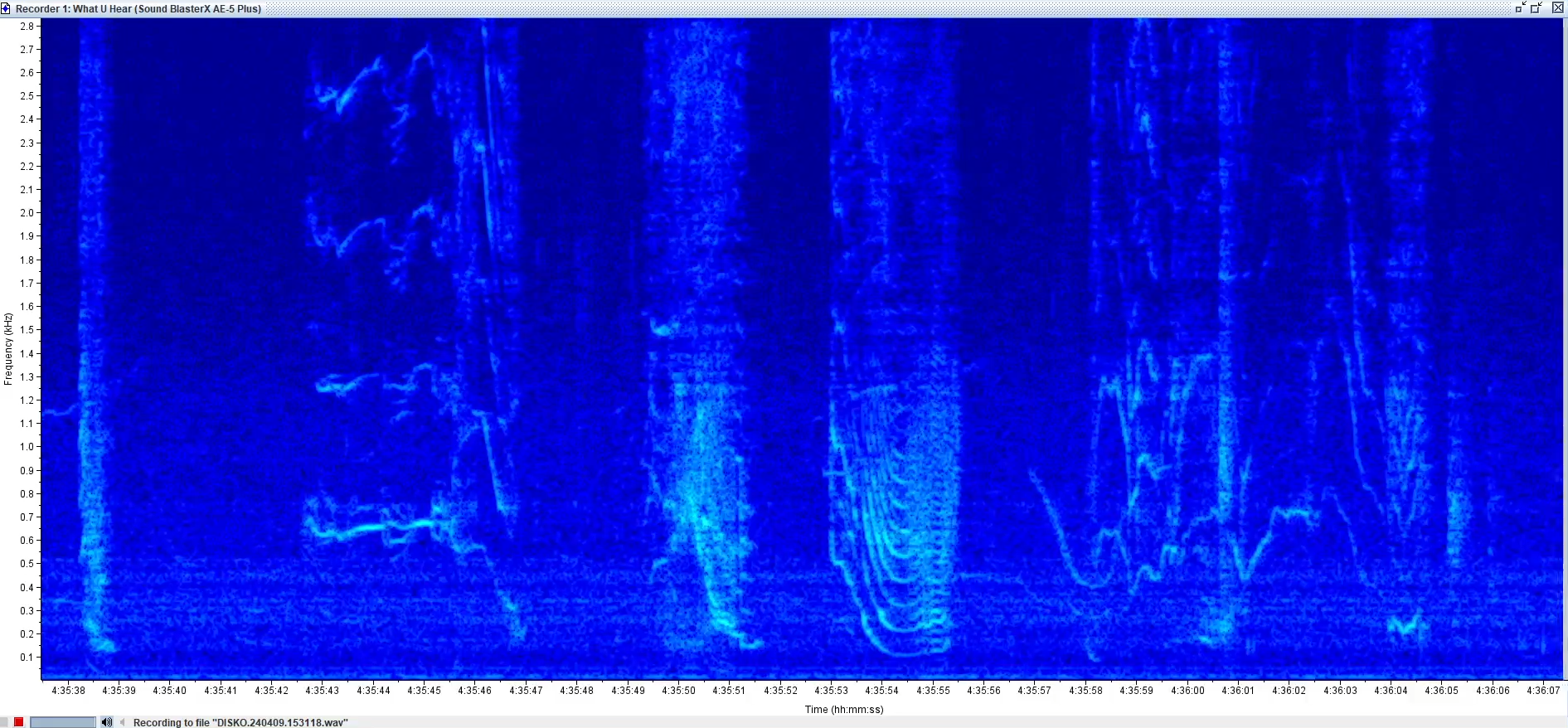
Greenland Listening Station

Seiche has collaborated with Dr. Outi Tervo of the Greenland Institute of Natural Resources and local stakeholders, to install an underwater acoustic observatory (or ‘Listening Station’) in western Greenland.

A hydrophone is cabled ashore to the Listening Station at Qaqqaliaq Lighthouse, near Qeqertarsuaq, Disko Island. This enables researchers to monitor the songs of bowhead whales, which breed in Disko Bay during the winter and spring. Bowhead whales sing elaborate, repetitive songs, probably as a reproductive display, and are known for biphonation or two-voiced vocalisation. Researchers will use passive acoustic monitoring (PAM) to gain insights into their seasonal occurrence and activity in the bay.

Qaqqaliaq Lighthouse is remote, unmanned and ice-bound for much of the year, so the hydrophone signal is transmitted from the lighthouse in real-time, via a 4G data link. The underwater soundscape can now be monitored continuously, from any location with internet access. Alongside the bowheads, the fascinating underwater soundscape of in Disko Bay features calving ice bergs, beluga whales and narwhals, fishing boats, and the long trills of male bearded seals.

🎧 Dr. Tervo provides public access to the live audio stream at the Disko Live home page www.diskolive.com – take a listen. An interactive display is under development for visitors to Qaqqaliaq.

Industry Events Calendar

Where can you catch up with the Seiche team across the globe? We have the following events on our schedule for the coming year, with many more to follow – are you attending any of them? If so, we would love to see you!

2025
22 – 23 JanuaryOffshore Wind
29 JanuaryMarine Measurement Forum
8 – 10 AprilWind Europe, Copenhagen
8 – 10 AprilOcean Business, Southampton
21 – 22 MayEAGE/SBGf Workshop
2 – 5 JuneEAGE Workshop, Toulouse
17 – 18 JuneGlobal Offshore Wind
29 June – 4 JulyEffects of noise on aquatic life, Prague

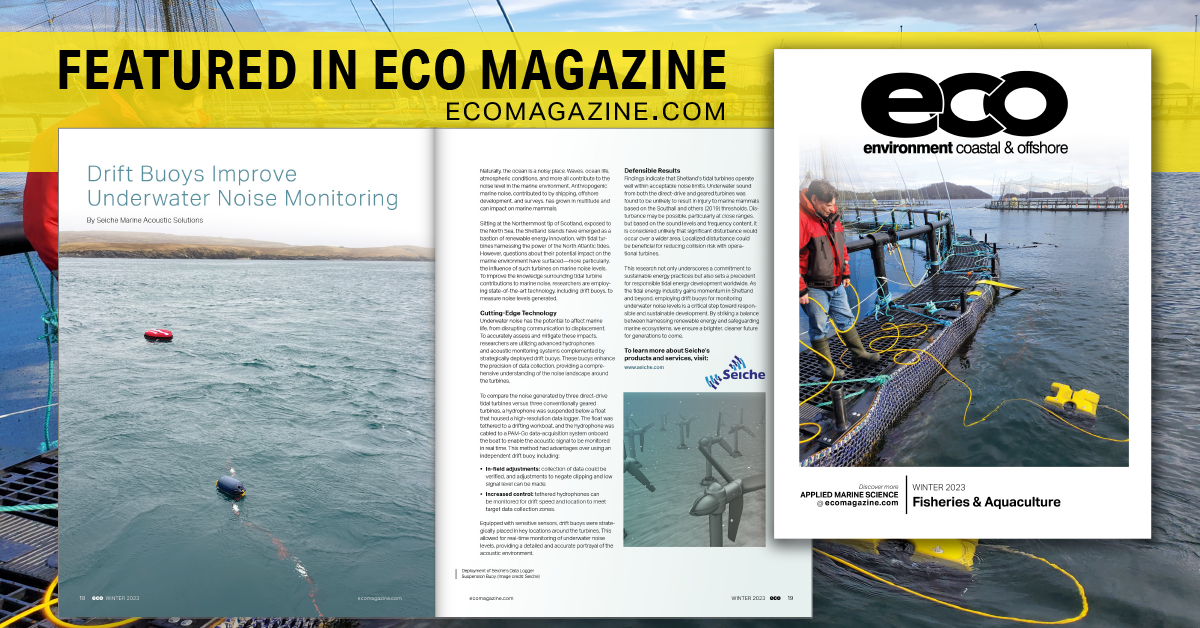
Drift Buoys Improve Underwater Noise Monitoring

The winter issue of Environment, Coastal and Offshore Magazine (ECO) highlights an article about our data loggers and drift buoys and how they were utilised to measure underwater noise on tidal turbines. This study aimed to identify the possible impact of such noise on marine life near the coast of Shetland.

Don’t miss the opportunity to read the article on page 18/19 by clicking on the following link:http://digital.ecomagazine.com/eco-winter-2023/page-18

Addressing Climate Change

By Mark Burnett , Director – Special Operations at Seiche Group

Climate change poses a significant threat to our world, with rising sea levels, increased natural disasters, and disrupted ecosystems. To combat this global challenge, we must understand the changes occurring in our oceans. This is where the remarkable AutoNaut Uncrewed Surface Vehicle (USV) comes into play. In this article published by Petroc, Mark Burnett discusses the revolutionary technology in more detail.

Click here to read the full article

Plymouth Marine Laboratory raise the roof with Seiche’s remote monitoring AI camera.

As part of their ongoing work to expand AI monitoring capabilities, Plymouth Marine Laboratory are testing the capabilities of our dual camera system on the roof of their laboratory looking out over the Plymouth Sound.

Focusing on the long-range detection of boats, birds and marine life, our thermal imaging and high definition camera complements PML’s current remote monitoring technology, with further trials in the pipeline. 

We look forward to the findings of the observation!

Your Eyes on the Ocean – Smart Visual Detection System

Embark on a Groundbreaking Journey: Introducing our First Trained Model on Whale Blows for our Gen2 camera, including Southern Right Whales.

Click on this video link for a valuable insight into our powerful camera: https://youtu.be/CtlAeIgdxdo

About Smart Visual Detection System:

  • Equipped with a dual camera setup, SVDS captures high-definition video and infrared imagery, ensuring 24 hour surveillance of the waters surrounding your vessel.
  • Designed with robustness and compactness in mind, SVDS is easy to ship, install and perfect for maritime use.
  • The system features impressive computing power more powerful than previous generations.
  • With powerful on-board processing and storage, SVDS enables real-time automated detection.
  • Our advanced pan and tilt system allows for user-configurable automatic scanning of an area up to 360 degrees, giving you comprehensive coverage.
  • SVDS builds on decades of experience in visual and underwater acoustic maritime monitoring, merging it with state-of-the-art technology originally found in self-driving vehicles.

For more information, download our datasheet or contact our team.

Opening – Smart Sound Plymouth

Great to be at the official opening of the Smart Sound Plymouth, Connect Control Centre at Oceansgate Limited, this morning with MBTC, Plymouth Marine Laboratory, University of Plymouth, University of Exeter, and The Marine Biological Association.

Smart Sound Plymouth is Britain’s premier proving area for designing, testing and developing cutting edge products and services for the marine sector, and is ideally suited for building and supporting the next generation of advanced marine technologies.

Co-ordinated through the Marine Business Technology Centre, Smart Sound Plymouth is a partnership between five organisations boasting considerable expertise in autonomous systems, environmental sensor technologies, alternative propulsion, advanced manufacturing and cyber security.

Field Trials – Plymouth Marine Laboratory

Thanks to Plymouth Marine Laboratory, in particular to Jani Pewter and Dr James Fishwick, for supporting field trials of our new camera systems. Taking the tech to the roof of PML, the Penlee data observatory and Rame Head.

They are hoping to trial this further on their research vessel The Quest. Stay tuned!

Rob Lee joins the team as Lead Marine Acoustician

We’re delighted to welcome Rob Lee to the team as Lead Marine Acoustician, following our growth in underwater acoustic modelling and monitoring and in particular the demand we’re seeing due to the offshore renewables market. With 11 years’ experience in underwater acoustics, Rob has a great depth of knowledge in both software and hardware development and their deployment at sea.
 
Rob will be instrumental in the development of new technology to keep ahead of the curve in meeting and exceeding our clients’ needs within the ever-evolving underwater noise market.
 
Rob comments: “I am incredibly excited to be joining Seiche, a company that I’ve long admired. I look forward to bringing all the skills I’ve acquired over the years to an organisation that is devoted to the understanding and protection of the underwater soundscape.”
 
Simon Stephenson, Senior Marine Acoustician at Seiche said: “It is fantastic to see our team expanding and we are thrilled to welcome Rob to the team. Not only does he bring fantastic experience with him, but his skills will help us develop industry-leading and innovative solutions for the offshore renewables market.”
 
Welcome to the team Rob, great to have you on board!